Earlier last year, Waymo collaborated with Uber to bring their highly anticipated driverless taxi service to Atlanta. I was initially skeptical about how Waymos would interact with the peculiar style of driving that plagues our city, but after a few trips in one, I'm bullish on Waymo. Every time I see one, I'm briefly filled with the hope that the future The Jetsons promised to us is within reach. But many Americans my age seem to think it's a sign of our impending dystopian hellscape, and it's not hard to see what's driving their skepticism.
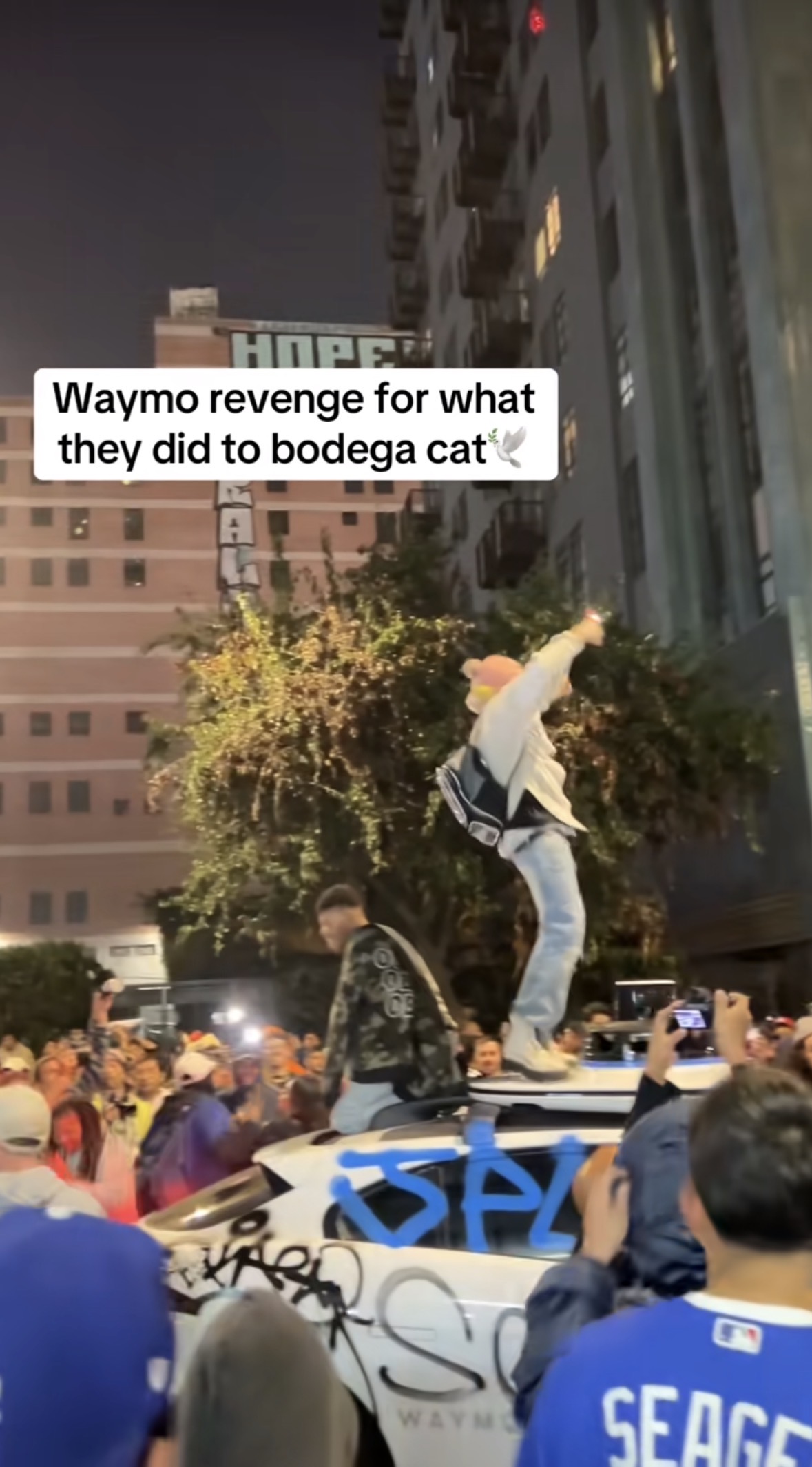
Case in point: a few months ago, a Waymo in San Francisco struck and killed a beloved bodega cat named KitKat. My TikTok feed was filled to the brim with tributes to KitKat, under which comments seethe about clankers and promising retribution against the autonomous vehicles. One video captioned 'Waymo revenge for what they did to bodega cat 🕊️' shows a teen dancing on top of a graffiti-ed out Waymo. (though this is probably related to the chaos that engulfed LA streets after the Dodgers World Series win).
Had a human driver ran over KitKat, there'd probably be no similar call to arms against unsafe street design, lenient driving penalties, or letting cats roam outdoors. But because KitKat was killed by the quasi-callous actions of 'the algorithm', its death is met with cries to halt autonomous rides. Never mind that Waymos are safer than both regular human drivers and rideshare operators. (Personal bonus: I don't have to roll a dice on whether or not my ride to an interview will reek of pot and bad air freshener). No one cares about data when there's a viral cause to rally behind. KitKat is dead, and he was murdered by a capitalist's shiny new toy.
Here's a short biography of a young technopessimist. Six days after you're born in 2006, Twitter launches. Shortly after your first birthday, iPhones hit shelves in the US. While you're in kindergarten, Facebook goes public. In the 5th grade, you watch Donald Trump get elected president, an outcome at least partly fueled by your parents' stolen data getting turned into ammunition against their own neighbors. You're finishing 8th grade when a pandemic shuts down the world, and high school starts through a laptop screen. Your life narrows into a slump between your bedroom and the TikTok algorithm. A year later, ChatGPT was released. It's convenient for writing essays, but by the time you're handed your diploma, you can't tell an article from a noun.
That was 2024. The next year, NVIDIA's market cap hit $4.9 trillion, and you start wondering if whatever you're training for will still exist by the time you're qualified to do it.
You could take the easy route and call this generational cynicism, or scrape the bottom of the barrel for another "Gen Z can't do X" thinkpiece. But our generation has folded a new movement into the omnicause: Luddism. Young Americans no longer believe in the idea that technical progress is tied to their prosperity.
I can't say I blame us entirely. Who among us has not yearned for the analog after a night of doomscrolling? But I am of the belief that the long arc of history bends toward a future à la Star Trek, and while our institutions of science are far from perfect, I still think we're early in something worth finishing.
But since I don't have billions of dollars to dull my instincts, I still audibly groan at poorly placed em dashes and shiver at the implications of being able to generate ultra-realistic videos of whatever and whoever we want. Many of my peers in tech do not seem to share these reservations. After a brief reflection period, Silicon Valley has trundled on with the move-fast-break-things mentality, especially concerning generative AI.
Tech companies are running out of road. Opposition to data centers is now a 70-30 issue, one of the few things Democrats and Republicans actually agree on. DeFlock, a map that helps drivers avoid license plate readers, went viral because people are done waiting for the law to catch up and started building their own workarounds. Even politicians have noticed: an anti-AI stance is turning into a winning one. This isn't fringe luddism anymore. Regulation looks like a when, not an if, and it's happening right as American techies can't afford to lose any ground to China.
Something has to give.
Read The Room
The first fix is simple. Tech bros, for the love of God, stop permanent underclass posting. Yes, this includes TPOT and C-suite executives gloating in commencement speeches and press interviews. Young Americans do not like watching their employment, agency, and future treated as a punchline. It's beyond bad optics. It's frankly anti-social. No amount of EA embellishing and productivity-slop will cover up the fact that your vision for the post-AI economy, joking or not, is borderline slavery. The alternative?
Put Up
Emphasize that a rising tide lifts all ships, and then delivers on that promise. Invest in the future. Hire juniors. AWS CEO Matt Garman called the idea of replacing junior employees with AI "one of the dumbest things I've ever heard", and Amazon is hiring 11,000 interns and new grads this year because of it. That's the right instinct. It's just hard to square with the fact that the same company has cut jobs since last October and plans to replace them with agents. Pick one (ideally the one that doesn't promise mass unemployment) and stick with it.
Earn Trust
Literally just stop being creepy. Flock Safety has a real opportunity to tackle crime, my family has dealt with car thefts and break-ins, so I get the appeal, and I'd rather live in a high-trust society than a locked-down one. But high trust has to be earned, not assumed, and Flock has a lot of work to put in. In December, a researcher found dozens of Flock cameras sitting wide open on the internet, no password required, including one pointed at a children's gymnastics room. Flock never apologized. Instead their CEO called the guy who mapped the cameras "terroristic." Build it in from the start, patch what's broken, kill what can't be fixed.
I really, really want to keep being bullish on this stuff. Companies keep making that harder than it needs to be. There's a real difference between an accident and negligence, and tech keeps blurring the two. Keep it up, and the backlash stops being about a bodega cat or a camera pointed at a gymnastics room. It becomes policy. And the world doesn't stop moving just because we do. I don't want to spend my twenties rooting against the industry I'm about to work in. Stop giving me reasons to.